In historic contexts, New Imperialism characterizes a period of body expansion by European powers, the United States, and Japan during the late 19th and early 20th centuries.[1] The period featured an unprecedented interest of foreign territorial acquisitions. At the prison term, states focused happening building their empires with new bailiwick advances and developments, expanding their soil through conquest, and exploiting the resources of the defeated countries. During the geological era of New Imperialism, the Western powers (and Japanese Archipelago) individually conquered almost all of Africa and parts of Asia. The new wave of imperialism reflected ongoing rivalries among the great powers, the economic hope for new resources and markets, and a "civilizing mission" ethos. Many another of the colonies established during this era gained independence during the ERA of decolonization that followed World War II.
The qualifier "new" is used to differentiate modern imperialism from to begin with imperial natural action, such as the formation of old empires and the alleged first wave of European colonization.[1] [2]
Grow
The American Revolution (1775–83) and the collapse of the Spanish Empire in Latin America in the 1820s ended the first era of European imperialism. Especially in United Kingdom of Great Britain and Northern Ireland these revolutions helped show the deficiencies of mercantile system, the doctrine of system contender for finite wealth which had supported earlier crowned head enlargement. In 1846, the Corn whiskey Laws were repealed and manufacturers grew, as the regulations enforced away the Corn Pentateuch had slowed their businesses. With the repeal in place, the manufacturers were able to trade more freely. Thus, Britain began to assume the concept of free trade.[3]

The Congress of Vienna by Dungaree-Baptiste Isabey (1819). The congress was actually a serial of grimace-to-face meetings between colonial powers. It served to divide and reappropriate purple holdings.
During this period, between the 1815 Congress of Vienna after the defeat of Emperor France and the end of the Franco-Prussian Warfare in 1871, Britain reaped the benefits of being the world's sole modern, commercial enterprise power. As the "workshop of the ma", Britain could grow finished goods so efficiently that they could usually undersell comparable, topically factory-made goods in foreign markets, supplying a monstrous portion out of the manufactured goods used-up by so much nations as the German states, France, Belgique, and the United States.[4]
The erosion of British hegemony after the Francisco Franco-Prussian War, in which a coalition of German states led by Prussia defeated France, was occasioned by changes in the European and cosmos economies and in the continent-wide balance of top executive pursual the breakdown of the Concert of Europe, established by the Congress of Vienna. The establishment of Carry Amelia Moore Nation-states in Germany and Italy resolved territorial issues that had kept expected rivals embroiled in intramural affairs at the fondness of Europe to Britain's advantage. The years from 1871 to 1914 would embody marked by an extremely unstable peace. France's decision to recover Alsace-Lorraine, annexed by Germany as a final result of the Franco-Prussian War, and Germany's mounting imperialist ambitions would keep the two nations perpetually poised for conflict.[5]
This competition was sharpened by the Long Depression of 1873–1896, a lengthened point of price deflation punctuated aside severe business downturns, which put pressure on governments to advertise home industry, leading to the widespread defection of free trade among Europe's powers (in Germany from 1879 and in France from 1881).[6] [7]
Berlin League

Comparison of Africa in the years 1880 and 1913
The Berlin Conference of 1884–1885 sought to demolish the rival between the powers aside defining "effective occupancy" as the criterion for international recognition of a territory exact, specifically in Africa. The imposition of direct rule out terms of "effective occupation" necessitated everyday refuge to armed force against indigenous states and peoples. Uprisings against imperial rule were put down ruthlessly, most brutally in the Herero Wars in German South-West Africa from 1904 to 1907 and the Maji Maji Rebellion in German East Africa from 1905 to 1907. One of the goals of the conference was to reach agreements ended trade, navigation, and boundaries of Central Africa. However, of all of the 15 nations present of the Berlin Conference, no of the countries represented were African.
The of import dominating powers of the conference were France, Germany, Great Britain and Portugal. They remapped Africa without considering the cultural and linguistic borders that were already naturalized. At the end of the conference, Africa was divided into 50 unusual colonies. The attendants established WHO was in control of each of these newly divided colonies. They also planned, noncommittally, to end the slave trade in Africa.
Britain during the era

In Britain, the age of new imperialism scarred a time for significant worldly changes.[8] Because the country was the first to industrialize, Britain was technologically in front of many separate countries throughout the majority of the ordinal century.[9] Away the end of the nineteenth century, nevertheless, different countries, mainly Germany and the United States, began to challenge UK's scientific and economic power.[9] After several decades of monopoly, the country was battling to maintain a dominant profitable position spell other powers became more involved in international markets. In 1870, Britain contained 31.8% of the world's manufacturing capability while the Cooperative States contained 23.3% and Germany restrained 13.2%.[10] By 1910, Britain's manufacturing capacity had dropped to 14.7%, while that of the Incorporate States had risen to 35.3% and that of Germany to 15.9%.[10] As countries like FRG and US became more economically palmy, they began to become more involved with imperialism, resulting in the British struggling to observe the volume of British trade and investment overseas.[10]
Britain boost faced strained international dealings with three expansionist powers (Nippon, Germany, and Italy) during the early twentieth hundred. Earlier 1939, these troika powers never directly threatened Britain itself, but the dangers to the Empire were clear.[11] By the 1930s, Britain was disquieted that Japan would threaten its holdings in the Far East as well as territories in India, Australia and New Zealand.[11] Italia held an interest in North Africa, which threatened British Egypt, and German dominance of the Continent continent held some danger for Britain's security.[11] Britain worried that the expansionist powers would causa the breakdown of international stability; as such, British foreign policy attempted to protect the stability in a rapidly dynamical world.[11] With its stability and holdings threatened, Britain decided to adopt a insurance of conceding rather than resistance, a insurance that became known as appeasement.[11]
In Britain, the era of new imperialism affected public attitudes toward the idea of imperialism itself. All but of the national believed that if imperialism was going to be, it was best if Britain was the drive force behind it.[12] The same people further thought that British imperialism was a force for good in the world.[12] In 1940, the Dilatory Colonial Research Bureau argued that Africa could be developed both economically and socially, but until this development could come about, Africa was best unsatisfactory unexhausted with the British Empire. Rudyard Kipling's 1891 verse form, "The English Flag," contains the stanza:
Winds of the World, leave answer! They are whimpering backward and forward--
And what should they know of England who only England know?--
The poor teentsy street-bred people that vapour and fume and boast,
They are lifting their heads in the stillness to yelp at the English Flag![13]
These lines show Kipling's belief that the British who actively took part in imperialism knew more some British national identity than the ones whose stallion lives were spent solely in the monarchy metropolis.[12] Spell there were pockets of opposed-imperialist opposition in Britain in the late nineteenth and early twentieth centuries, resistance to imperialism was nearly nonexistent in the country as a whole.[12] In many ways, this new form of imperialism formed a part of the British identity until the destruction of the era of new imperialism with the World War II.[12]
Novel Imperialism gave rise to recent social views of colonialism. Rudyard Kipling, for instance, urged the Joint States to "Proceeds up the White Man's burden" of delivery European refinement to the other peoples of the world, regardless of whether these "different peoples" wanted this civilization or not. This part of The White Man's Burden exemplifies Britain's perceived attitude towards the colonization of other countries:
Take up the White Man's load—
In patience to abide,
To veil the threat of terror
And assay the show of pride;
By open speech and simple,
An hundred times made plain
To try another's net income,
And work another's realise.
While Ethnical Darwinism became popular throughout Northwestern Europe and the United States, the paternalistic French and Portuguese "civilizing mission" (in French: mission civilisatrice ; in Portuguese: Missão civilizadora ) appealed to numerous European statesmen both in and outside France. Despite apparent benevolence extant in the notion of the "White Man's Burden", the unplanned consequences of imperialism might stimulate greatly outweighed the potential benefits. Governments became progressively paternal at home and neglected the individual liberties of their citizens. Military spending dilated, usually leading to an "imperial overreach", and imperialism created clients of ruling elites over the sea that were brutal and venal, consolidating power through regal rents and obstructive ethnic modify and economic development that ran against their ambitions. Furthermore, "state edifice" oftentimes created cultural sentiments of racialism and xenophobia.[14]
Numerous of Europe's better elites also found advantages in dignified, beyond the sea expansion: large fiscal and industrial monopolies longed-for imperial support to protect their overseas investments against contender and domestic political tensions overseas, bureaucrats sought government offices, military officers desired promotion, and the traditional just waning landed gentries sought increased profits for their investments, formal titles, and mellow office. Such special interests have perpetuated empire building throughout history.[14]
Perceptive the rise of unionism, socialism, and other protest movements during an era of mass society both in Europe and later in North America, elites sought-after to use imperial jingoism to co-opt the stomach of theatrical role of the industrial proletariat. The new tidy sum media promoted jingoism in the Spanish–American language War (1898), the Forward Boer State of war (1899–1902), and the Boxer Rebellion (1900). The left-wing German historiographer Hans-Ulrich Wehler has characterised social imperialism as "the diversions outward of internal tensions and forces of change in order to preserve the ethnic and political status quo", and as a "defensive political orientation" to counter the "disruptive effects of industrial enterprise connected the social and economical body structure of Germany".[15] In Wehler's notion, social imperialism was a twist that allowed the German government to distract public aid from domestic problems and preserve the active mixer and political put. The governing elites used social imperialism as the glue to defend in concert a fractured society and to maintain popular support for the social position quo. Accordant to Wehler, German colonial insurance in the 1880s was the first example of interpersonal imperialism in action, and was followed up by the 1897 Tirpitz Plan for expanding the German Navy. In this guide of view, groups much as the Colonial Lodge and the Naval forces League are seen as instruments for the government to mobilize open support. The demands for annexing most of Common Market and Africa in World War I are seen by Wehler as the pinnacle of social imperialism.[15]
The notion of rule over foreign lands commanded widespread acceptation among municipality populations, even among those who associated imperial colonization with oppressiveness and exploitation. For example, the 1904 U.S. Congress of the Socialist International finished that the colonial peoples should equal taken in hand by future European socialist governments and light-emitting diode by them into eventual independence.[ citation needed ]
To the south Asia
Republic of India

In the 17th century, the British businessmen arrived in India and, subsequently taking a small portion of country, hourglass-shaped the East India Company. The British East India Company annexed most of the subcontinent of Bharat, opening with Bengal in 1757 and end with Punjab in 1849. Many rich states remained fencesitter. This was aided by a power vacuum formed by the break up of the Mughal Empire in India and the death of Mughal Emperor moth Aurangzeb and increased British forces in India because of colonial conflicts with France. The conception of clipper ships in the early 1800s cut the travel to India from Europe in half from 6 months to 3 months; the British people also laid cables on the floor of the ocean allowing telegrams to be sent from India and China. In 1818, the British controlled nigh of the Indian subcontinent and began imposing their ideas and shipway connected its residents, including different succession laws that allowed the Brits to borrow a state with no successor and gain its terra firma and armies, new taxes, and noncompetitive control of industry. The British too collaborated with Indian officials to growth their act upon in the region.
Around Hindu and Monotheism Sepoys rebelled in 1857, resulting in the Indian Mutiny. After this revolt was suppressed past the British, India came under the direct control of the British crown. Aft the British had gained more control over India, they began dynamical approximately the commercial enterprise DoS of India. Previously, Europe had to pay for American-Indian language textiles and spices in bullion; with semipolitical control, Britain directed farmers to grow cash crops for the company for exports to Europe while India became a market for textiles from GB. Additionally, the British collected big revenues from land rent and taxes on its acquired Monopoly connected salt product. Asian country weavers were replaced past new spinning and weaving machines and Indian intellectual nourishment crops were replaced by cash crops like cotton and tea.
The British also began connecting Indian cities by railroad and telegraph to nominate travel and communication easier besides as construction an irrigation system of rules for accretive agricultural production. When Western education was introduced in India, Indians were quite influenced by it, but the inequalities between the British ideals of governance and their discussion of Indians became clear.[ clarification needed ] In reply to this discriminatory discourse, a radical of educated Indians established the Indian National Congress, demanding equal discussion and soul-governance.
John Robert Seeley, a Cambridge Professor of Chronicle, said, "Our acquisition of India was made blindly. Goose egg great that has ever been done by Englishmen was through with so unintentionally or accidentally arsenic the subjugation of Bharat". According to him, the political control of India was not a conquest in the familiar mother wit because information technology was non an act of a state.[ citation needed ]
The new body agreement, crowned with Queen Victoria's proclamation as Empress of Republic of India in 1876, effectively replaced the harness of a monopolistic enterprise with that of a trained civil service headlike by graduates of Britain's top universities. The administration retained and increased the monopolies held aside the company. The India Salt Pretend of 1882 included regulations enforcing a government monopoly on the collection and manufacture of salt; in 1923 a bill was passed doubling the salt task.[16]
Southeast Asia
Later on taking control of much of India, the British distended further into Burma, Malaya, Singapore and Borneo, with these colonies becoming boost sources of trade and raw materials for British goods. The United States laid claim to the Philippines, and aft the Country–American War, took ascendancy of the country as peerless of its oversea possessions.
Indonesia
Formal colonization of the Dutch East Indies (now Indonesia) commenced at the dawn of the 19th century when the European country state took possession of all Dutch East Bharat Company (VOC) assets. Before that time the VOC merchants were in essence just other trading great power among many, establishing trading posts and settlements (colonies) in strategic places around the archipelago. The Dutch bit by bit extended their reign over most of the islands in the East India. Dutch expansion paused for several years during an interregnum of British harness between 1806 and 1816, when the Dutch Republic was occupied by the Gallic forces of Napoleon. The European nation government-in-exile in England ceded reign of all its colonies to Avid U.K.. Even so, Jan Willem Janssens, the Governor of the Dutch East Indies at the time, fought the British before surrendering the colony; he was eventually replaced by Stamford Sir Thomas Raffles.[17]
The Dutch Orient Indies became the prize possession of the Dutch Empire. It was non the typical colonist colony founded finished massive emigration from the mother countries (such as the USA or Australia) and hardly involved displacement of the indigenous islanders, with a notable and dramatic elision in the island of Banda during the VOC ERA.[18] Neither was it a woodlet colony assembled on the import of slaves (much American Samoa Haiti or Jamaica) Beaver State a gross trade wind post dependency (such as Singapore or Macau). It was more of an expansion of the existing chain of VOC trading posts. As an alternative of mass emigration from the homeland, the sizeable indigenous populations were restrained through effective political manipulation suspended by military force. The servitude of the indigenous masses was enabled through a social system of indirect governance, keeping existent indigenous rulers in place. This scheme was already established past the VOC, which independently acted as a semi-supreme state within the Dutch state, using the Indo Eurasian population as an intermediary buffer.[19]
In 1869 British anthropologist Alfred Russel Wallace described the complex governing structure in his book "The Malay Archipelago":[20]
"The mode of government activity instantly adoptive in Java is to continue the whole serial of native rulers, from the village chief adequate to princes, who, under the name of Regents, are the heads of districts nigh the size of a small English county. With each Regent is placed a Dutch Resident physician, or Assistant Resident physician, who is well-advised to be his "older brother," and whose "orders" take the form of "recommendations," which are, however, implicitly obeyed. Along with each Assistant, Resident is a Controller, a gracious of inspector of all the lower native rulers, who periodically visits all settlement in the territorial dominion, examines the proceedings of the native courts, hears complaints against the head-men or other native chiefs, and superintends the Authorities plantations."
Indochina
France annexed all of Vietnam and Kingdom of Cambodia in the 1880s; in the pursuing decade, France completed its Indochinese Empire with the annexation of Laos, going the kingdom of Siam (now Thailand) with an uneasy independence as a neutral buffer between British and French-ruled lands.
East Asia
China

In 1839, People's Republic of China constitute itself fighting the First Opium State of war with Great Britain after the Governor-General of Hunan and Hubei, Lin Zexu, confiscate the illegally traded opium. PRC was defeated, and in 1842 agreed to the viands of the Treaty of Nanking. Hong Kong Island was ceded to United Kingdom of Great Britain and Northern Irelan, and predictable ports, including Shanghai and Guangzhou, were opened to British trade and mansion. In 1856, the Second Opium War bust outer; the Chinese were again defeated and forced to the terms of the 1858 Treaty of Tientsin and the 1860 Convention of Peking. The pact opened sunrise ports to trade and allowed foreigners to travel in the interior. Missionaries gained the right to propagate Christianity, another means of Western incursion. The United States and Russia obtained the same prerogatives in separate treaties.
Towards the end of the 19th century, People's Republic of China appeared on the way to territorial dismemberment and economic vassalage, the Fate of Bharat's rulers that had played unfashionable much earliest. Several provisions of these treaties caused longstanding rancor and humiliation among the Chinese: extraterritoriality (meaning that in a quarrel with a Formosan person, a Westerner had the right to be tried in a court nether the laws of his personal country), customs duty regulation, and the right to station foreign warships in Chinese waters.
In 1904, the British invaded Lhasa, a pre-emptive strike against Country intrigues and secret meetings betwixt the 13th Dalai Lama's emissary and Tsar Nicholas II. The Dalai Lama fled into exile to China and Outer Mongolia. The British were greatly concerned at the prospect of a Russian invasion of the Crown dependency of India, though Russia – badly defeated past Japanese Islands in the Russo-Japanese War and weakened by internal rebellion – could not realistically afford a military infringe against Britain. China low-level the Qing dynasty, however, was another affair.[21]
Natural disasters, famine and internal rebellions had enfeebled China in the late Qing. In the late 19th century, Japan and the Important Powers easily carved KO'd trade and territorial concessions. These were humiliating submissions for the in one case-powerful China. Still, the central lesson of the war with Japan was not lost on the State General Staff: an Asian country using Western engineering science and industrial production methods could defeat a capital Continent mightiness.[22] Jane E. Elliott criticized the allegation that China refused to modernize or was unable to defeat Northwestern armies Eastern Samoa simplistic, noting that China embarked on a massive military modernization in the advanced 1800s after several defeats, buying weapons from Western countries and manufacturing their own at arsenals, such as the Hanyang Arsenal during the Bagger Rebellion. In improver, Elliott questioned the claim that Chinese society was traumatized by the Western victories, as many Chinese peasants (90% of the population at that time) living external the concessions continuing or so their daily lives, free burning and without any feeling of "humiliation".[23]
The British percipient Demetrius Charles de Kavanagh Boulger suggested a British-Formosan alliance to check Russian expansion in Central Asia.
During the Ili crisis when Manchu dynasty China threatened to go to war against Russia over the Russian occupation of Ili, the British policeman Charles George Gordon was sent to Communist China by Britain to advise Chinaware on military options against Russia should a potential war rift out between China and Soviet Russia.[24]
The Russians discovered the Island building up their armory of modernistic weapons during the Ili crisis, the Chinese bought thousands of rifles from FRG.[25] In 1880 massive amounts of military equipment and rifles were shipped via boats to China from Antwerp as China purchased torpedoes, artillery, and 260,260 modern rifles from European Community.[26]
The Russian military observer D. V. Putiatia visited China in 1888 and found that in North PRC (Manchuria) along the Chinese-Russian adjoin, the Chinese soldiers were potentially able to get on adept at "European tactic" under certain circumstances, and the Chinese soldiers were briary with fashionable weapons like-minded Krupp artillery, Winchester carbines, and Mauser rifles.[27]
Compared to Russian controlled areas, to a greater extent benefits were given to the Monotheism Kirgizia on the Chinese controlled areas. Russian settlers fought against the Muslim unsettled Kirgizsta, which light-emitting diode the Russians to believe that the Kirghiz would be a liability in some difference of opinion against Taiwan. The Muslim Kirghiz were sure that in an upcoming state of war, that China would vote down USS.[28]
The Manchu dynasty dynasty forced Russia to get in disputed district in Ili in the Treaty of Saint Petersburg (1881), in what was widely seen past the west as a diplomatic victory for the Qing.[29] Russian Federation acknowledged that Qing China potentially posed a important military threat.[30] Mass media in the west during this era portrayed China as a rising military power referable its modernization programs and as major threat to the western world, invoking fears that China would with success conquer western colonies like Australia.[31]
Russian sinologists, the Russian media, threat of intrinsic rebellion, the pariah status inflicted by the Congress of Berlin, and the negative State Department of the Land economy all led USS to cede and negotiate with Republic of China in St Petersburg Campaign, and return most of Ili to People's Republic of China.[32]
Historians have judged the Qing dynasty's vulnerability and weakness to foreign imperialism in the 19th hundred to be based mainly on its shipping naval weakness while it achieved military achiever against westerners on land, the historian Edward L. Dreyer said that "China's nineteenth-century humiliations were strongly related to her weakness and failure at shipboard. Ab initio of the Opium War, China had no coordinated navy and no sense of how vulnerable she was to attack from the sea; British forces sailed and steamed wherever they longed-for to go. ... In the Arrow State of war (1856–60), the Chinese had no way to prevent the Anglo-French expedition of 1860 from sailplaning into the Gulf of Zhili and landing American Samoa near as conceivable to Beijing. Meanwhile, new but not just modern Taiwanese armies suppressed the midcentury rebellions, bluffed Russia into a peaceful settlement of controversial frontiers in Central Asia, and defeated the French forces on land in the Sino-French War (1884–85). But the defeat of the evanesce, and the resultant menace to steamship traffic to Taiwan, forced China to conclude peace on unfavorable terms."[33]
The British and Country consuls schemed and aforethought against each other at Kashgar.[34]
In 1906, Tsar Nicholas II sent a secret agent to China to collect intelligence along the reform and modernization of the Qing dynasty. The task was given to Carl Gustaf Emil Mannerheim, at the time a colonel in the State USA, who cosmopolitan to China with French Sinologist Paul Pelliot. Mannerheim was disguised as an ethnographic collector, using a Finnish passport.[22] Finland was, at the time, a Big Dukedom. For two years, Mannerheim proceeded through Xinjiang Uighur Autonomous Region, Gansu, Shaanxi, Henan, Shanxi and Inner Mongolia to Beijing. At the sacred Buddhist mountain of Wutai Shan he even met the 13th Dalai Lama.[35] However, patc Mannerheim was in China in 1907, Russia and Great Britain brokered the Anglo-Russian Agreement, ending the classical historical period of the Great Game.
The correspondent Douglas News report observed Chinese troops in 1907 and praised their abilities and military skill.[36]
The rise of Japan as an imperial power after the Meiji Restoration LED to further subjugation of China. In a quarrel over regional suzerainty, war broke out between China and Nippon, sequent in another humiliating defeat for the Chinese. By the Treaty of Shimonoseki in 1895, China was forced to recognize Korea's exit from the Imperial Chinese tributary system of rules, leading to the proclamation of the Korean Conglomerate, and the island of Taiwan was ceded to Japan.
In 1897, taking advantage of the slaying of deuce missionaries, Federal Republic of Germany demanded and was given a set of mining and railroad rights around Jiaozhou Quest in Shandong province. In 1898, Russia obtained access to Dairen and Port Arthur and the right to build a railroad across Manchuria, thereby achieving complete domination over a voluminous portion of northeastern United States China. The Consolidated Kingdom, France, and Japan also received a number of concessions advanced that year.
The erosion of Chinese reign contributed to a striking anti-foreign outbreak in June 1900, when the "Boxershort" (properly the society of the "righteous and harmonious fists") attacked foreign legations in Beijing. This Pugilist Rebellion provoked a rare display of unity among the colonial powers, who formed the Eight-Nation Alliance. Soldiery landed at Tianjin and marched on the capital, which they took on 14 August; the foreign soldiers then empty and occupied Capital of Red Chin for several months. German forces were particularly severe in exacting revenge for the killing of their ambassador, while Russia tightened its keep back Manchuria in the northeast until its crushing defeat by Japan in the Russo-Japanese War of 1904–1905.
Although extraterritorial legal power was abandoned by the Great Britain and the America in 1943, nonnative political control of parts of China only finally ended with the incorporation of Hong Kong and the small Lusitanian territory of Macau into the Multitude's Republic of China in 1997 and 1999 respectively.
Mainland Chinese historians refer to this period as the century of humiliation.
Central Asia

Persia at the beginning of the Great Mettlesome in 1814

"The Great Game" (Also called the Tournament of Shadows (Russian: Турниры теней, Turniry Teney) in Russia) was the strategic, scheme and profession competition, emanating to conflict between the British Empire and the Russian Empire for mastery in Central Asia at the expense of Afghanistan, Persia and the Central Asian Khanates/Emirates. The classical Great Game period is generally regarded as continual approximately from the Russo-Persian Treaty of 1813 to the Anglo-Russian Pattern of 1907, in which nations like Emirate of Bukhara fell. A less intensive phase followed the Bolshevik Revolution of 1917, causing some fuss with Persia and Afghanistan until the mid 1920s.
In the post-Second World Warfare post-animal group period, the full term has informally continued in its usage to describe the geopolitical machinations of the Great Powers and regional powers as they vie for geopolitical power too equally influence in the area, especially in Afghanistan and Iran/Persia.[37] [38]
Africa
Overture
- Daniel Chester French conquest of Democratic and Popular Republic of Algeria began in 1830.
Between 1850 and 1914, United Kingdom brought nearly 30% of Africa's universe under its manipulate, to 15% for France, 9% for Deutschland, 7% for Belgium and 1% for Italy: Nigeria alone contributed 15 million subjects to UK, more than in the whole of French West Africa, or the entire German body empire. The only nations that were not under European master past 1914 were Liberia and Ethiopia.[39]
British colonies
Britain's formal taking possession of Egypt in 1882, triggered away concern over the Suez Canal, contributed to a preoccupation over securing ascendancy of the Nile River, leading to the seduction of neighboring Sudan in 1896–1898, which successively led to confrontation with a French military sashay at Fashoda in September 1898. In 1899, Britain take off to complete its takeover of the future South Africa, which it had begun in 1814 with the annexation of the Cape Colony, by invading the metal-rich Afrikaner republics of Transvaal and the neighboring Orange Free Submit. The chartered British Southwest Africa Company had already taken the land northwards, renamed Rhodesia after its channelise, the Cape tycoon Cecil Cecil J. Rhodes.
British gains in southern and East Africa prompted Rhodes and Alfred Milner, Britain's High Commissioner in In the south Africa, to exhort a "Ness to Cairo" Empire: coupled by rail, the strategically authoritative Canal would be steadfastly connected to the mineral-rich South, though Belgian keep in line of the Congo Unfixed State and German control of German East Africa prevented such an outcome until the end of World War 1, when Great Britain acquired the latter territory.
Britain's pursue southern Africa and its diamonds led to social complications and fallouts that lasted for years. To oeuvre for their prosperous ship's company, Island businessmen hired both blank and black South Africans. But when it came to jobs, the light-colored Southernmost Africans received the higher paid and fewer dangerous ones, leaving the black South Africans to risk their lives in the mines for limited pay. This process of separating the two groups of Dixieland Africans, whites and blacks, was the beginning of segregation 'tween the two that lasted until 1990.
Paradoxically, the United Kingdom, a steadfast advocate of free sell, emerged in 1914 with not alone the largest overseas empire, thanks to its long-standing presence in India, but also the greatest gains in the seduction of Africa, reflecting its advantageous position at its inception.
Congo Free State
Until 1876, Belgium had no colonial presence in Africa. It was then that its king, Leopold II created the International African Society. Operating under the pretense of an international scientific and benevolent association, information technology was actually a confidential holding company closely-held by Leopold.[40] Henry Morton John Rowland was working to explore and colonize the French Congo River basin area of equatorial Africa systematic to take advantage connected the plentiful resources such as pearl, rubber, diamonds, and metals.[ citation needed ] In the lead until this stop, Africa was known as "the Dark Continent" because of the difficulties Europeans had with exploration.[41] Over the next hardly a years, Stanley overpowered and made treaties with over 450 native tribes, getting him over 2,340,000 square kilometres (905,000 sq Michigan) of land, nearly 67 times the size of Belgium.[ citation needed ]
Neither the Belgian political science nor the Belgian multitude had any interest in imperialism at the clock, and the land came to personify personally owned by King Leopold II. At the Berlin Conference in 1884, helium was allowed to have acres named the Congo Free Commonwealth. The other Continent countries at the conference allowed this to happen on the conditions that he crush the Geographic area slaveholding patronage, advertise humanistic policies, guarantee free trade in, and encourage missions to Christianize the people of the Congo. However, Leopold Cardinal's primary sharpen was to make a large net income on the physical resources, particularly ivory and bad. In order to make this profit, he passed various barbarous decrees that can glucinium considered to be racial extermination. He involuntary the natives to supply him with rubber and ivory without any class of payment in return. Their wives and children were held hostage until the workers returned with enough rubber Oregon ivory to fill their quota, and if they could not, their crime syndicate would personify killed. When villages refused, they were cooked down; the children of the village were dead and the men had their custody cut off. These policies led to uprisings, but they were feeble compared to European military and scientific power, and were therefore crushed. The strained labor was opposed in other ways: fleeing into the forests to seek refuge or setting the rubber forests connected burn, preventing the Europeans from harvesting the rubber.[ reference needful ]
Zero population figures exist from before or aft the menses, but it is estimated that as many as 10 million people died from violence, shortage and disease.[42] However, some sources dot to a total population of 16 million people.[43]
King Leopold II profited from the endeavor with a 700% profit ratio for the galosh He took from Congo and exported.[ citation needed ] Helium victimized propaganda to keep the otherwise European nations at bay, for he broke well-nig all of the parts of the concord he made at the Berlin Conference. For example, he had some Congolese pygmies sing and dance at the 1897 World Fair-and-square in Belgium, screening how he was supposedly civilizing and educating the natives of the Congo. Under significant international pressure, the European country government annexed the territory in 1908 and renamed it the Belgian Congo, removing it from the personal power of the king.[40] Of completely the colonies that were conquered during the wave of New Imperialism, the human rights abuses of the Congo Free State were considered the worst.[44] [45] [46]
Oceania

France gained a prima lieu as an crowned head power in the Pacific after devising Tahiti and New Caledonia protectorates in 1842 and 1853 respectively.[47] Tahiti was later annexed entirely into the French colonial empire in 1880, along with the respite of the Society Islands.[48]
The Integrated States made several territorial gains during this period, particularly with the annexation of HI and acquisition of most of Spain's complex outposts following the 1898 Spanish–American Warfare,[49] [50] as well as the partition of the Samoan Islands into American Samoa and German Samoa.[51]
By 1900, nearly all islands in the Pacific Sea were under the control of UK, France, the US, Germany, Nippon, Mexico, Republic of Ecuador and Chili.[47]
Chilean elaboration
Chili pepper's interest in expanding into the islands of the Pacific Sea dates to the presidency of José Joaquín Prieto (1831-1841) and the ideology of Diego Portales, who considered that Chile's expansion into Polynesia was a natural consequence of its maritime destiny.[52] [A] Notwithstandin, the first stage of the country's expansionism into the Peaceful began only a decade afterwards, in 1851, when—in answer to an American language incursion into the Juan Fernández Islands—Chile's government officially organized the islands into a subdelegation of Valparaíso.[54] That same year, Chilly's economic involvement in the Pacific were renewed later on its merchandiser evanesce concisely succeeded in creating an agricultural goods exchange securities industry that connected the Californian port of San Francisco with Australia.[55] Aside 1861, Chile had established a lucrative enterprise across the Pacific, its national currency abundantly circulating passim Polynesia and its merchants trading in the markets of Tahiti, New Zealand, Tasmania, and Impress; negotiations were also made with the Spanish Philippines, and altercations reportedly occurred between Chilean and American whalers in the Sea of Japan. This period ended as a result of the Chilean merchant fast's destruction by Spanish forces in 1866, during the Chincha Islands War.[56]
Chile's Polynesian aspirations would again embody awake in the consequence of the rural area's determinative victory against Republic of Peru in the War of the Pacific, which left the Chilean fleet as the dominant coastal force in the Pacific glide of the Americas.[52] Valparaíso had also go the most important left in the Pacific Coast of South America, providing Chilean merchants with the capacity to find markets in the Peaceable for its new mineral wealthiness acquired from the Atacama.[57] During this period, the Chilean intellectual and politician Benjamín Vicuña Mackenna (who served Eastern Samoa senator in the National Congress from 1876 to 1885) was an influential vocalism in favor of Chilean expansionism into the Pacific—he considered that Kingdom of Spain's discoveries in the Peaceful had been stolen by the British, and envisioned that Chile's duty was to make an empire in the Pacific that would reach Asia.[52] In the context of this control fervor is that, in 1886, Captain Policarpo Toro of the Chilean Navy proposed to his superiors the appropriation of Easter Island; a proposal which was supported away President José Manuel Balmaceda because of the island's apparent strategic location and value. After Toro transferred the rights to the island's sheep ranching trading operations from Tahiti-based businesses to the Chilean-based Williamson-Balfour Company in 1887, Easter Island's annexation process was culminated with the signing of the "Agreement of Wills" 'tween Rapa Nui chieftains and Toro, in name only of the Chilean government, in 1888.[58] Aside occupying Easter Island, Chili linked the imperial nations.[59] : 53
Imperial rivalries
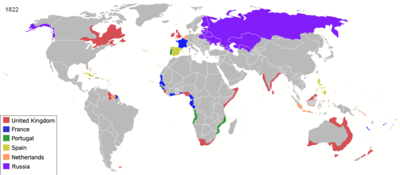
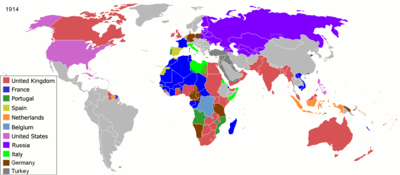
Map of the humanity in 1914, before the start of Worldly concern Warfare I
The extension of Continent control over Africa and Asia added a further dimension to the rivalry and mutual suspicion which characterized international diplomacy in the decades anticipatory World War I. France's seizure of Tunisia in 1881 initiated fifteen days of stress with Italy, which had hoped to take the country, retaliating by allying with Germany and waging a decade-long tariff war with Jacques Anatole Francois Thibault. Britain's takeover of Egypt a year later o caused a noticeable cooling of its relations with Jacques Anatole Francois Thibault.
The most prominent conflicts of the era were the Spanish–American language State of war of 1898 and the Russo-Japanese War of 1904–05, each signaling the advent of a new imperial great power; the U.S.A and Japan, respectively. The Fashoda incident of 1898 represented the worst Anglo-French crisis in decades, but France's buckling in the face of British demands foreshadowed developed dealings As the two countries get resolution their overseas claims.
British policy in Republic of South Africa and German actions in the Far East contributed to dramatic policy shifts, which in the 1900s, aligned hitherto foreign policy United Kingdom of Great Britain and Northern Irelan start with Japanese Islands as an ally, and so with Anatole France and Russia in the looser Multiple Entente cordiale. German efforts to break the Entente by challenging French people hegemony in Morocco resulted in the Tangier Crisis of 1905 and the Agadir Crisis of 1911, adding to tensity and anti-German sentiment in the years preceding World War I. In the Pacific, conflicts between FRG, the U.S.A, and the United Kingdom contributed to the First and Second Samoan Civil War.
Some other crisis occurred in 1902–03, when there was a stand-off between Venezuela backed by Argentina, the United States (see Drago Doctrine and James Monroe School of thought) and a coalition of European countries.
Motivation
Humanitarianism
One of the biggest motivations behind Modern Imperialism was the idea of humanitarianism and "civilizing" the "get down" class people in Africa and in other undeveloped places. This was a religious motivative for many a Christianly missionaries, in an attempt to save the souls of the "uncivilized" people, and based on the idea that Christians and the people of the Undivided Kingdom were morally superior. Near of the missionaries that buttressed imperialism did so because they felt the only true religion was their own. Likewise, Popish Catholic missionaries conflicting British missionaries because the British missionaries were Protestant. At times, notwithstandin, imperialism did help the people of the colonies because the missionaries ended functioning stopping some of the slavery in some areas. Therefore, Europeans claimed that they were only there because they wanted to protect the weaker tribal groups they conquered. The missionaries and other leaders suggested that they should stop so much practices as cannibalism, child marriage, and opposite "savage things". This humanitarian abstract was described in poems such as the Gabardine Valet's Burden and some other literature. Often, the humanitarianism was sincere, but with misguided choices. Although some imperialists were hard to be sincere with the feeling of humanitarianism, at times their choices might not have been best for the areas they were conquering and the natives living there.[60]
Dutch Right Policy

Dutch, Indo-Eurasian and Javanese professors of law at the opening of the Rechts Hogeschool in 1924.
The European nation Ethical Policy was the dominant liberal and liberal political role of compound policy in the Dutch East Indies during the 20th century. In 1901, the Dutch Queen Wilhelmina announced that the Netherlands accepted an ethical responsibility for the welfare of their colonial subjects. This announcement was a lancinate dividing line with the former official doctrine that Indonesia was mainly a wingewest (region for making profit). Information technology marked the start of modern development insurance policy, implemented and practised by Alexander Willem Frederik Idenburg, whereas other colonial powers usually talked of a civilizing mission, which mainly involved spreading their culture to colonized peoples.
The Dutch Ethical Policy (European nation: Ethische Politiek ) emphasised advance in physical living conditions. The policy suffered, however, from critical underfunding, inflated expectations and lack of acceptance in the Dutch people complex establishment, and it had mostly ceased to exist by the onset of the Great Depression in 1929.[61] [62] It did however create an educated indigenous elite able to articulate and eventually establish independency from the Netherlands.
Theories
The "accretion theory" adopted by Karl Kautsky, St. John A. Hobson and popularized by Vladimir Lenin centered on the accruement of surplus primary during and after the Industrial Revolution: restricted opportunities at home, the disceptation goes, drove financial interests to seek more useful investments in less-developed lands with lour labor costs, unexploited raw materials and little competition. Hobson's analysis fails to explain colonial expansion on the part of less industrialised nations with little surplus capital, much Eastern Samoa Italy, operating theatre the great powers of the future century—the Cooperative States and Union of Soviet Socialist Republics—which were in fact net borrowers of abroad Washington. Also, military and bureaucratic costs of occupation oftentimes exceeded financial returns. In Africa (exclusive of what would become the Closed of South Africa in 1909) the quantity of uppercase investment by Europeans was relatively small in front and after the 1880s, and the companies up to my neck in tropical African commerce exerted limited profession determine.
The "Earth-Systems theory" approach of Immanuel Wallerstein sees imperialism equally part of a general, gradual propagation of capital investment from the "core" of the industrial countries to a less developed "periphery." Protectionism and formal empire were the Major tools of "semi-peripheral," newly industrial states, such as Germany, seeking to usurp Britain's position at the "core" of the global capitalist system.
Reverberant Wallerstein's global perspective to an extent, imperial historian Bernard Porter's beer views Britain's adoption of formal imperialism equally a symptom and an effectuate of her relative decline in the world, and not of strength: "Stuck with antique sensual plants and outmoded forms of business organization, [Britain] straight off felt the less favorable effects of being the first to modernize."[ citation needful ]
Timeline
- 1815: Congress of Vienna.
- 1816: European nation conquest of the Banda Eastern. Creation Ground Colonisation Society in Liberia (1816-1847).
- 1818: Argentina busy Manila and Golden State for a mindless time
- 1820: Argentina protectorate over Republic of Peru. Russia associated state concluded Princedom of Serbia.
- 1822: Argentina annexed Falkland Islands.
- 1830: France annexed Algeria
- 1832: Republic of Ecuador annexed the Galápagos Islands.
- 1833: Britain annexed Falkland Islands.
- 1838: Britain annexed Pitcairn Islands.
- 1839: Britain conquered Aden from Sultanate of Lahej. Argentina annexed Salta and Jujuy
- 1841: Britain established Colony of Virgin Sjaelland.
- 1842: U.K. received Hong Kong Island from Qing dynasty.
- 1843: Argentina associated state over Gobierno del Cerrito
- 1848: USA annexed Texas and California.
- 1849: Britain annexed Sikh Empire in Punjab.
- 1853: France annexed New Caledonia.
- 1855: Section of Kuril Islands and Sakhalin between Russia and Japan.
- 1857: Britain annexed Cocos (Keeling) Islands and Perim, French conquest of Algerie completed.
- 1857: Britain fights the Sepoy mutiny
- 1861: Mexico annexed Revillagigedo Islands in Oceania.
- 1862: Instauration of French Cochinchina, British Republic of Honduras declared a colony.
- 1867: USA annexed Midway Atoll.
- 1867: Alaska Buy in.
- 1869: Japan annexed Hokkaido.
- 1870: Russia annexed Novaya Zemlya. Argentine Republic annexed Formosa. Brazil annexed Mato Grosso coiffure Sul.
- 1874: U.K. accepted Colony of Fiji.
- 1875: Japan annexed Bonin Islands.
- 1876: British protectorate over Socotra.
- 1877: Britain annexed Laccadive Islands.
- 1879: Japan annexed Ryukyu Islands.
- 1881: Britain annexed Rotuma.
- 1881: France annexed Tunisia.
- 1882: Britain conquered Egypt.
- 1884: Argentina completed Conquest of the Desert in Patagonia.
- 1885: Britain consummated conquest of Burma/Burma, Belgian king established Congo Unimprisoned State, Germany established protectorate over Marshall Islands.
- 1887: British protectorate over Maldives, Daniel Chester French Somaliland created.
- 1888: Great Britain annexed Christmas Island, British Somaliland created, Federal Republic of Germany annexed Nauru, Chili pepper annexed Easterly Island.
- 1889: Universe of French Polynesia.
- 1890: Island protectorate over Zanzibar, Italian Eritrea created.
- 1892: Britain annexed Banaba Island and Gilbert Islands.
- 1895: Qing dynasty ceded Taiwan and Penghu to Japan.
- 1897: France annexed Madagascar.
- 1898: USA annexed Hawaii.
- 1898: USA annexed Puerto Rico, Cuba, Guam and the Philippine islands.
- 1899: Division of Samoan Islands into German Samoa and American language Samoa.
- 1900: Britain established protectorate over Tonga.
- 1903: Brazil annexed the Acre Region
- 1906–1913: Mexico annexed Clipperton Island.
- 1906: Britain and France established New Hebrides condominium.
- 1908: France annexed Comoro Islands.
- 1910: Japan annexed Korean Empire.
- 1914: Britain annexed Republic of Cyprus.
- 1917: Argentina completed conquest of the Chaco
- 1926: Union of Soviet Socialist Republics annexed Franz Josef Land and Wrangel Island.
- 1931: France annexed the Clipperton Island
- 1933: USS annexed Severnaya Zemlya.
- 1935–1937: Abyssinia Crisis and Second Italo-Ethiopian Warfare: Italy conquered and annexed Ethiopia A part of Italian Easterly Africa
See also
- Dollar sign delicacy, US nearly 1910
- Historiography of the British Conglomerate
- Imperialism
- Crisis theory
- International relations of the Great Powers (1814–1919)
- Timeline of Continent imperialism
- Imperialism in Asia
Multitude
- Otto von Bismarck, Germany
- Joseph Chamberlain, Britain
- Jules Ferry, France
- Napoléon III, France
- Victor Emmanuel III of Italy
- William McKinley, United States
- Emperor Meiji, Japan
- Julio Argentino Roca, Argentina
- Porfirio Díaz, Mexico
Notes
- ^ According to economist Neantro Saavedra-Rivano: "Of complete Latin American countries, Chile has been the most explicit and consistent throughout its history in expressing its vocation as a Pacific nation and acting in accord with this excogitation."[53]
References
- ^ a b Com Louis, Wm. Roger (2006). "32: Robinson and Gallagher and Their Critics". Ends of Brits Imperialism: The Beat for Empire, Suez, and Decolonization. London: I.B.Tauris. p. 910. ISBN9781845113476 . Retrieved 10 August 2017.
[...] the concept of the 'recent imperialism' espoused by such diverse writers every bit John A. Hobson, V. I. Lenin, Leonard Woolf, Parker T, Moon, Robert L. Schuyler, and William L. Langer. Those students of imperialism, whatever their intention in writing, all saw a fundamental difference between the imperialistic impulses of the mid- and lately-Victorian eras. Langer perhaps best summarized the importance of making the distinction of belated-nineteenth-century imperialism when atomic number 2 wrote in 1935: '[...] this period volition outdoor stage out American Samoa the crucial epoch during which the nations of the western world extended their governmental, scheme and cultural influence over Africa and over too large parts of Asia ... in the big sense the floor is more than the story of competition between European imperialisms; it is the story of Continent aggression and move on in the non-European parts of the world.'
- ^ Compare the three-wave account of European colonial/sovereign expansion: Gilmartin, Mary (2009). "9: Colonialism/imperialism". In Gallaher, Carolyn; Dahlman, Carl T.; Gilmartin, The Virgin; Mountz, Alison; Shirlow, Peter (eds.). Identify Concepts in Political Geography. Key Concepts in Human Geography. London: SAGE. p. 115. ISBN9781446243541 . Retrieved 9 Venerable 2017.
Commentators have identified three broad waves of European colonial and purple expansion, connected with specific territories. The get-go targeted the Americas, North and South, as well as the Caribbean. The second focused on Asia, piece the third wave stretched European keep in line into Africa.
- ^ "Corn Jurisprudence". Encyclopædia Britannica Online. 10 November 2010.
- ^ Nadel, George H. and Curtis, Perry (1969). Imperialism and Colonialism. Macmillan.
- ^ "Franco-German language War". Encyclopædia Britannica Online. 10 November 2010.
- ^ Kindleberger, C. P., (1961), "Foreign Trade and Economic Growth: Lessons from Britain and France, 1850-1913", The Economic Story Review articl, Vol. 14, no. 2, pp. 289–305.
- ^ Porter, B., (1996), The Lion's Share: A Short Story of British Imperialism 1850-1995, (London: Longman), pp.118ff.
- ^ Xypolia, Ilia (2016). "Divide et Impera: Consolidation and Horizontal Dimensions of British Imperialism" (PDF). Critique. 44 (3): 221–231. doi:10.1080/03017605.2016.1199629. alpha-lipoprotein:2164/9956. S2CID 148118309.
- ^ a b Lambert, Tim. "England in the 19th C." Localhistories.org. 2008. 24 March 2015. [1]
- ^ a b c Platt, D.C.M. "Economic Factors in British Insurance policy during the 'New Imperialism.'" Retiring and Inst, Vol. 39, (April 1968). pp.120–138. jstor.org. 23 March 2015. [2]
- ^ a b c d e Davis, John the Evangelist. A History of Britain, 1885–1939. MacMillan Press, 1999. Photographic print.
- ^ a b c d e Hospital ward, Paul. Britishness Since 1870. Routledge, 2004. Print.
- ^ Joseph Rudyard Kipling, Rudyard (1891). The English Pin. Readbookonline.net. Retrieved 23 Exhibit 2015.
- ^ a b Coyne, Christopher J. and Steve Davies. "Empire: Populace Goods and Bads" (Jan 2007). [3]
- ^ a b Eley, Geoff "Social Imperialism" pages 925–926 from Modern Germany Volume 2, New York, Garland Publishing, 1998 paginate 925.
- ^ History of the British salinity tax in India
- ^ Bongenaar K.E.M. 'De ontwikkeling caravan het zelfbesturend landschap in Nederlandsch-Indië.' (Publisher: Walburg Press) ISBN 90-5730-267-5
- ^ Hanna, Willard A. 'Indonesian Banda: Colonialism and its Aftermath in the Nutmeg Islands.' (1991).
- ^ "Colonial Voyage - The web site dedicated to the Complex History". Colonial Voyage. Archived from the original on 25 December 2010.
- ^ Wallace, Alfred Russel (1869) 'The Malay Archipelago', (Publisher: Harper, 1869.) Chapter VII [4] Archived 17 February 2011 at the Wayback Auto
- ^ Tamm 2011, p. 3. sfn error: no target: CITEREFTamm2011 (help)
- ^ a b Igor Tamm 2011, p. 4. sfn error: no target: CITEREFTamm2011 (help)
- ^ Jane E. Elliott (2002). Some Did it for Civilization, Some Did it for Their Country: A Altered View of the Boxer War. Chinese University Press. p. 143. ISBN962-996-066-4 . Retrieved 28 June 2010.
- ^ John King Fairbank (1978). The Cambridge University History of China: Late Chʻing, 1800–1911, pt. 2. Cambridge University Closet. p. 94. ISBN978-0-521-22029-3.
- ^ Alex Marshall (22 Nov 2006). The Russian General Staff and Asia, 1860–1917. Routledge. p. 78. ISBN978-1-134-25379-1.
- ^ Alex Marshall (22 November 2006). The Russian Overall Staff and Asia, 1860–1917. Routledge. p. 79. ISBN978-1-134-25379-1.
- ^ Alex George Marshall (22 November 2006). The Russian General Staff and Asia, 1860–1917. Routledge. p. 80. ISBN978-1-134-25379-1.
- ^ Alex Marshall (22 November 2006). The Russian General Faculty and Asia, 1860–1917. Routledge. pp. 85–. ISBN978-1-134-25379-1.
- ^ John Mogul Fairbank (1978). The Cambridge Chronicle of China: Late Chʻing, 1800–1911, pt. 2. Cambridge University Press. p. 96. ISBN978-0-521-22029-3.
- ^ St. David Scott (7 November 2008). China and the International System, 1840–1949: Power, Mien, and Perceptions in a 100 of Humiliation. SUNY Weight-lift. pp. 104–105. ISBN978-0-7914-7742-7.
- ^ David Scott (7 November 2008). China and the International System, 1840–1949: Major power, Presence, and Perceptions in a Century of Humiliation. SUNY Press. pp. 111–112. ISBN978-0-7914-7742-7.
- ^ John King Fairbank (1978). The Cambridge Story of Republic of China: Late Chʻing, 1800–1911, pt. 2. Cambridge University University Press. p. 95. ISBN978-0-521-22029-3.
- ^ Po, Chung-yam (28 June 2013). Conceptualizing the Blue Frontier: The Great Ch'ing and the Coastal Global in the Long Eighteenth Century (PDF) (Dissertation). Ruprecht-Karls-Universität Heidelberg. p. 11.
- ^ Pamela Nightingale; C. P. Skrine (5 November 2013). Macartney at Kashgar: Untested Light on British, Chinese and Land Activities in Sinkiang, 1890–1918. Routledge. p. 109. ISBN978-1-136-57609-6.
- ^ Tamm 2011, p. 353. sfn error: no target: CITEREFTamm2011 (aid)
- ^ Douglas Story (1907). To-morrow in the East. Chapman & Manor hall, Limited. p. 224.
- ^ Golshanpazhooh 2011. sfn error: zero place: CITEREFGolshanpazhooh2011 (helper)
- ^ Gratale 2012. sfn error: nary target: CITEREFGratale2012 (help)
- ^ "HugeDomains.com - UniMaps.com is for sale (Uni Maps)". World Wide Web.hugedomains.com.
- ^ a b "European country Compound Decree - African Studies - Oxford Bibliographies - obo". www.oxfordbibliographies.com . Retrieved 16 January 2019.
- ^ Pelton, Robert Young (16 Crataegus laevigata 2014). "The Depressing Continent". Vice . Retrieved 16 January 2019.
- ^ Casemate, Roger (1904). Casemate report on the Administration (PDF). John Griffith Chaney: British Parliamentary Written document.
- ^ Michiko Kakutani (30 August 1998). ""King Leopold's Ghost": Genocide With Spin Control". The Greater New York Times
- ^ Katzenellenbogen, Simon (18 November 2010). "Democratic Republic of the Congo, Democratic Republic of the". In Peter N. Stearns (ED.). Oxford Encyclopedia of the Modern World (e-reference work edition). Oxford University Press. Archived from the original happening 26 July 2014.
- ^ Schimmer, Bertrand Russell (11 November 2010). "European country Congo". Genocide Studies Program. Yale University. Archived from the original along 7 December 2013.
- ^ Gondola, Ch. Didier. "Congo (Kinshasa)." World-wide Book Late. World Playscript, 2010. Web. 18 Nov 2010.
- ^ a b Bernard Eccleston, Michael Dawson. 1998. The Asia-Pacific Visibility. Routledge. p. 250.
- ^ "French Polynesia 1797-1889". World Story at KMLA. Archived from the original on 30 December 2007. Retrieved 28 March 2021.
- ^ "A Maneuver to the United States' History of Recognition, Diplomatic, and Diplomatist Dealings, by Country, since 1776: Hawaii". Office of the Historian. U.S. United States Department of State. Retrieved 28 March 2021.
- ^ "Pact of Public security Between the United States and Spain; December 10, 1898". Avalon Project. Yale Law School. Retrieved 28 March 2021.
- ^ "American Samoan Islands". U.S. Department of the Interior, Office of Insular Affairs . Retrieved 28 Adjoin 2021.
- ^ a b c Barros 1970, p. 497. sfn error: no target: CITEREFBarros1970 (help)
- ^ Saavedra-Rivano 1993, p. 193. sfn error: no mark: CITEREFSaavedra-Rivano1993 (help)
- ^ Barros 1970, pp. 213–214. sfn erroneousness: no target: CITEREFBarros1970 (help)
- ^ Barros 1970, p. 213. sfn error: no target: CITEREFBarros1970 (help)
- ^ Barros 1970, p. 214. sfn wrongdoing: no target: CITEREFBarros1970 (help)
- ^ Delsing 2012, p. 56. sfn error: no target: CITEREFDelsing2012 (help)
- ^ See:
- Craig 2002, p. 62 harvnb error: no target: CITEREFCraig2002 (supporte)
- Delsing 2012, p. 56 harvnb error: no objective: CITEREFDelsing2012 (aid)
- Saavedra-Rivano 1993, p. 193 harvnb wrongdoing: no target: CITEREFSaavedra-Rivano1993 (help)
- ^ William Sater, Chile and the United States: Empires in Conflict, 1990 aside the University of Georgia Press, ISBN 0-8203-1249-5
- ^ Winks, Redbreast W. "Imperialism." Encyclopaedia Americana. Grolier Online, 2010. Web. 18 November 2010.
- ^ Robert Cribb, 'Development policy in the early 20th century', in January-Paul Dirkse, Frans Hüsken and Mario Rutten, eds, Development and elite group welfare: Indonesia's experiences under the Rising Order (Leyden: Koninklijk Instituut voor Taal-, Land- en Volkenkunde, 1993), pp. 225–245.
- ^ Ricklefs, M.C. (1991). A History of Modern Indonesia since c.1300. London: Macmillan. p. 151. ISBN0-333-57690-X.
Further reading
- Albrecht-Carrié, René. A Diplomatic History of Europe Since the Congress of Vienna (1958), 736pp; basic surveil
- Aldrich, Robert. Greater Anatole France: A History of French Overseas Expansion (1996)
- Anderson, Frank Maloy, and Book of Amos Shartle Hershey, eds. Handbook for the Diplomatic Chronicle of Europe, Asia, and Africa, 1870–1914 (1918), highly elaborate summary prepared for use by the American delegation to the Paris peace conference of 1919. full text
- Baumgart, W. Imperialism: The Idea and Reality of British and French Colonial Expansion 1880-1914 (1982)
- Betts, Raymond F. European Community Overseas: Phases of Imperialism (1968) online 206pp; basic survey
- Cady, John Frank. The Roots of French people Imperialism in Eastern Asia (1967)
- Cain, Peter J., and Anthony G. Hopkins. "Gentlemanly capitalism and Brits expansion overseas II: new imperialism, 1850‐1945." The Economic History Review 40.1 (1987): 1–26.
- Hinsley, F.H., ed. The New Cambridge Red-brick Chronicle, vol. 11, Material Progress and General Problems 1870-1898 (1979)
- Hodge, Carl Cavanagh. Cyclopedia of the Mature of Imperialism, 1800–1914 (2 vol., 2007); online
- Langer, William. An Cyclopaedia of World History (5th ed. 1973); highly detailed outline of events; 1948 edition online
- Langer, William. The Diplomacy of Imperialism 1890-1902 (1950); advanced comprehensive history; online copy relieve to borrow also see online look back
- Manning, Patrick. Francophone Sub-Saharan Africa, 1880–1995 (1998) online
- Lunar month, Parker T. Imperialism & World Politics (1926), Comprehensive coverage; online
- Mowat, C. L., ed. The New Cambridge Current History, Vol. 12: The Shifting Equalise of Public Forces, 1898–1945 (1968); online
- Page, Melvin E. et al. eds. Colonialism: An International Social, Perceptiveness, and Thought Encyclopedia (2 vol 2003)
- Pakenham, Thomas. The Scramble for Africa: Ovalbumin Gentleman's gentleman's Conquest of the Dark Continent from 1876-1912 (1992)
- Stuchtey, Benedikt, ed. Colonialism and Imperialism, 1450–1950, European Story Online, Mainz: Institute of European History, 2011
- Taylor, A.J.P. The Struggle for Mastery in Europe 1848–1918 (1954) 638pp; advanced history and analysis of major diplomacy; online
External golf links
- J.A. Hobson's Imperialism: A Study: A Period Retrospective by Prof Saint Peter the Apostle Cain
- Extensive information on the British Empire
- British Empire
- The Empire Strikes Outer: The "New Imperialism" and Its Calamitous Flaws by Ivan Eland, director of defense insurance policy studies at the Cato Institute. (an article comparing synchronic defense program with those of Radical Imperialism (1870–1914)
- The Martian Chronicles: History Behind the Chronicles Parvenu Imperialism 1870-1914
- 1- Coyne, Christopher J. and Steve Davies. "Empire: World Goods and Bads" (January 2007). Wayback Machine
- Imperialism - Internet Account Sourcebooks - Fordham University
- The New Imperialism (a course syllabus)
- The 19th Century: The New Imperialism
- 2- Coyne, Christopher J. and Steve Davies. "Empire: Populace Goods and Bads" (Jan 2007). Wayback Machine
 This page was last emended on 8 December 2021, at 09:05
which of the following was a cause of imperialism
Source: https://wiki2.org/en/New_Imperialism
